Ask five people on your team which AI Policy Template they use for work.
Would you get five honest, confident answers?
For most small businesses, the answer is no. Even businesses with a clear AI strategy for small businesses often skip this step.
It’s not because anyone is hiding anything.
It’s because nobody has ever written down what’s okay and what isn’t.
Why Small Businesses Need an AI Usage Policy
That gap is usually where problems start.
Not with a dramatic security incident. With a quiet, reasonable guess.
- A staff member isn’t sure if it’s fine to paste a customer list into a free AI tool, so they make a judgement call.
- Someone finds a useful new AI app and just starts using it, because there’s no process to check first.
None of this is reckless.
It’s simply what happens when there’s nothing simple to follow.
What Is an AI Policy Template for Small Business?
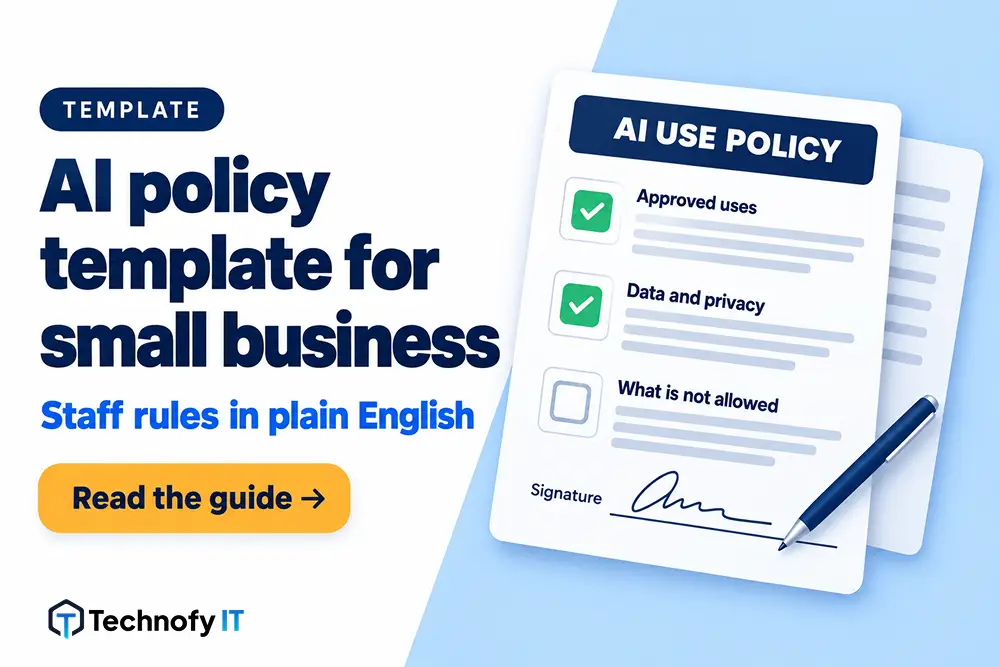
An AI policy template for small business is a one-page, plain-language guide that tells staff which AI tools are approved, what information must never go into any AI tool, and who to ask before trying something new.
It isn’t a legal document or a compliance framework.
It’s a quick reference your team can read in thirty seconds and actually remember.
Do You Need a Legal Document for Your AI Policy?
No.
Fixing this doesn’t require:
- a formal governance framework
- a lawyer
- a 20-page compliance document nobody will read
For a small business, a genuinely useful AI policy fits on one page.
Its job isn’t to cover every possible scenario. Its job is to answer the three questions your team actually needs answered at the moment.
1. Which AI Tools Are We Okay Using?
Staff need a clear, named list, not a vague “use common sense”.
2. What Information Should Never Go Into Any AI Tool?
This is where most of the risk sits, and it’s the same thinking behind practical cyber security controls for small businesses.
3. Who Do I Ask Before Trying Something New?
One person or role, so the question has an obvious home.
Get those three things written down clearly and you’ve closed off the vast majority of the risk that comes from AI tools being adopted informally.
In most SMBs, informally is exactly how they get adopted.
Why a Helpful AI Policy Beats a Strict One
It’s tempting to write a policy that reads like a list of rules and warnings.
Resist that.
The businesses that actually get compliance are the ones that make the policy easy to follow, not the ones that make it feel like a trap.
| Type of policy | What happens |
| One page, plain language, readable in thirty seconds | Staff remember it and follow it |
| Dense document buried in a shared drive | Nobody reads it, no matter how thorough it is |
The goal is a habit, not a paper trail. That’s the practical side of enterprise-grade IT thinking for Australian SMBs.
What to Include in an AI Policy: The One-Page Outline
Here’s a practical outline you can adapt.
This isn’t a legal template. It’s a structure that covers what actually matters for a small business.
1. Approved AI Tools List
A short, named list of the AI tools your business has actually checked and is comfortable with staff using.
2. Data That Never Goes Into an AI Tool
Spell it out plainly:
- customer details
- financial information
- passwords
- anything confidential or identifiable
3. Who to Ask Before Trying a New AI Tool
One named person (or role) staff can go when they find a useful AI tool that isn’t on the approved list yet.
4. How New AI Tools Get Approved
A quick, simple process, so “ask first” doesn’t become a bottleneck nobody bothers with. This matters more as you start adding AI automation to everyday work.
5. A Note on Responsibility
A line making clear that using AI tools for work still means following normal confidentiality and data-handling expectations.
6. Review Date
When the policy gets looked at again, it doesn’t quietly go stale as tools change.
Free One-Page AI Policy Template
Copy this structure and fill in the brackets for your business:
Approved AI tools: [List the AI tools your business has checked and approved]
Never put into any AI tool: Customer details, financial information, passwords, and anything confidential or identifiable.
Found a new AI tool? Ask [name or role] before you use it for work.
How approval works: [One or two lines on your quick approval process]
Your responsibility: Using AI tools for work still means following our normal confidentiality and data-handling expectations.
Next review: [Date]
That’s genuinely all it needs.
Any small business can put this together in an afternoon.
The hard part isn’t the writing. It’s making the decisions about what’s actually approved, and that’s worth doing properly rather than rushing.
When Should an SMB Write an AI Policy?
Now, not eventually.
AI tools aren’t slowing down, and neither is how quickly staff pick them up.
Businesses that wait until something goes wrong are, by definition, writing their policy after the fact:
- after a customer list has already gone somewhere it shouldn’t
- after an unapproved tool has already touched sensitive data
It’s a decision a virtual CTO would put near the top of the list, because the cost gap is so clear:
Write a one-page policy now → costs almost nothing
Clean up after an incident → costs considerably more, in time, trust and sometimes money
Is a One-Page AI Policy Template Worth It for Small Businesses?
Yes. It’s a small effort that closes off most of the risk from informal AI use.
It also doesn’t need to be perfect on day one.
Simple version: an honest one-page policy that gets reviewed and improved every few months.
Ambitious version: a thorough policy that never gets written because it feels like too big a project.
The simple version is far more useful.
FAQs
1. Which AI tools is our team already using?
Find out first. In most SMBs, tools have been adopted informally, so the real list is usually longer than you expect.
2. Which of those tools have we actually checked?
Only tools your business has checked and is comfortable with belong on the approved list.
3. What data genuinely needs protecting?
Start with customer details, financial information, passwords and anything confidential or identifiable. Our cyber security services for SMBs can help you work this out.
4. Who will staff ask about new tools?
Name one person or role, so there’s never any doubt about where to go.
5. Is our approval process quick enough to use?
If “ask first” feels like a bottleneck, people will skip it. Keep it simple.
6. Can a busy staff member read it in thirty seconds?
If not, cut it back. Plain language gets followed; dense documents don’t.
7. When will we review it?
Set a date, so the policy keeps up as AI tools change.
The Bottom Line
Most small businesses don’t have a written AI policy, so staff fill the gap with reasonable guesses.
A one-page AI policy template for small business fixes that by answering three questions: which tools are approved, what data stays out, and who to ask.
Keep it plain, keep it short and review it every few months.
If you know your business needs one but haven’t had time to write it, that’s exactly the kind of practical, unglamorous work our IT strategy and virtual CTO service helps SMBs with.
We’ll sit down with you, work out what tools you’re actually using and what data genuinely needs protecting.
Then we’ll help you put together a one-page AI policy for your small business that your team will actually read, not a document that sits in a folder collecting dust.
Have a chat with the TechnofyIT team. It’s a small conversation that closes off a surprising amount of risk.
Related read: How to Pick Your First AI Automation Project


